
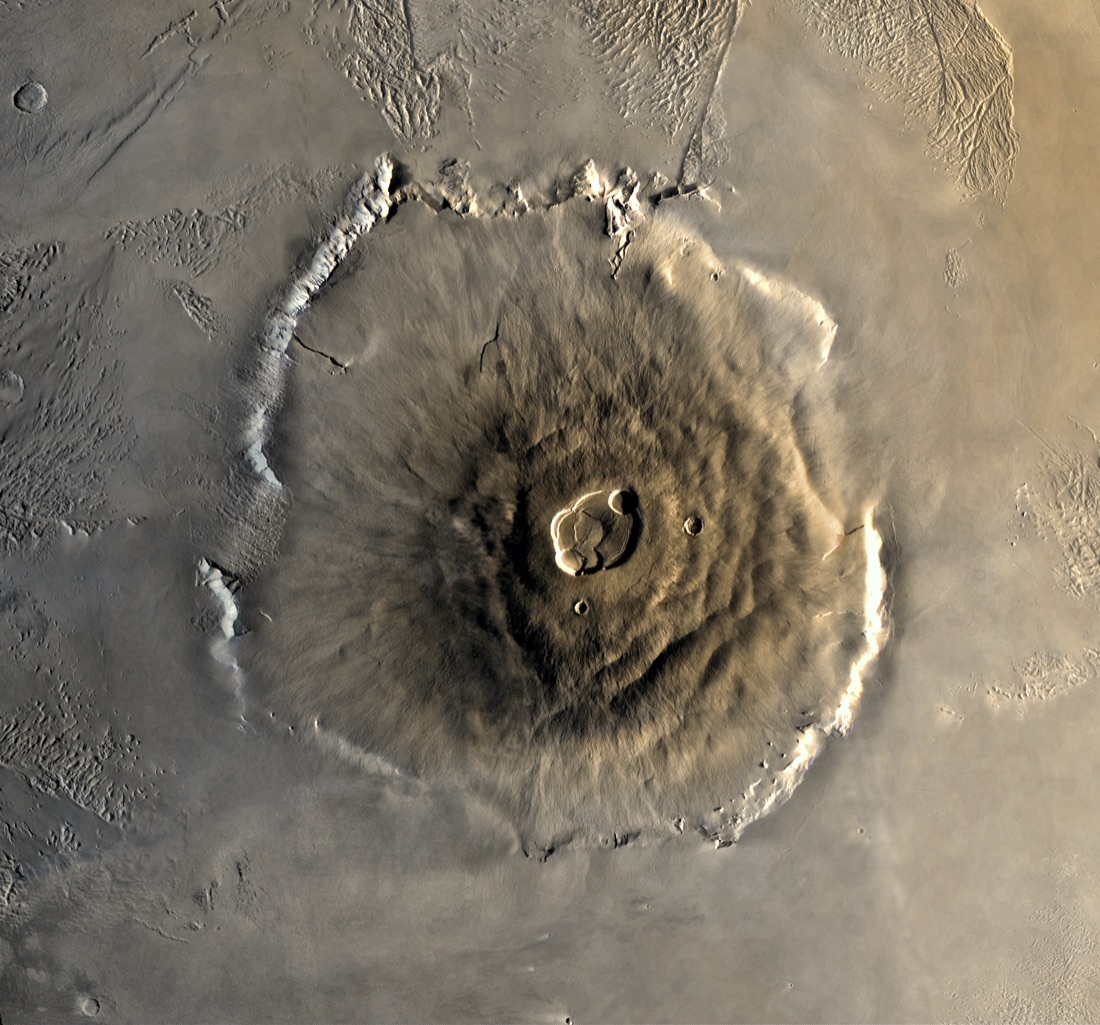
Thin carbon-dioxide air (about 600 Pa at the datum, far less at these summits), daytime highs near −20°F that plunge below −150°F at night, and planet-girdling dust storms. A pressure suit is mandatory.
29ers on Mars: Olympus Mons, Ascraeus Mons, Elysium Mons, Arsia Mons.
No breathable air, sulfur-dioxide frost, 300 km-high volcanic plumes, and a lethal bath of Jovian radiation. Io is the most volcanically active world in the solar system.
29ers on Io: Boösaule Montes, Ionian Mons, Euboea Montes.
The worst weather anywhere: a ~465°C surface, 90+ atmospheres of crushing carbon dioxide, and clouds of sulfuric acid. Maxwell Montes is the “coolest” spot on the planet — a balmy ~380°C.
29ers on Venus: Maxwell Montes.
Airless and frigid (about −190°F in sunlight). Surface gravity is roughly 0.025 g, so a careless step could launch you toward escape velocity.
29ers on Vesta: Rheasilvia.
Airless, about −225°F, and famously two-faced — one hemisphere is coal-black, the other bright ice. The equatorial ridge makes the whole moon look like a walnut.
29ers on Iapetus: Equatorial Ridge of Iapetus.
Actual weather! Wind, snow, and breathable air (less of it the higher you go). Comparatively hospitable — and, by solar-system standards, comparatively tiny.
29ers on Earth: Mauna Kea, Mauna Loa, Mount Everest.